
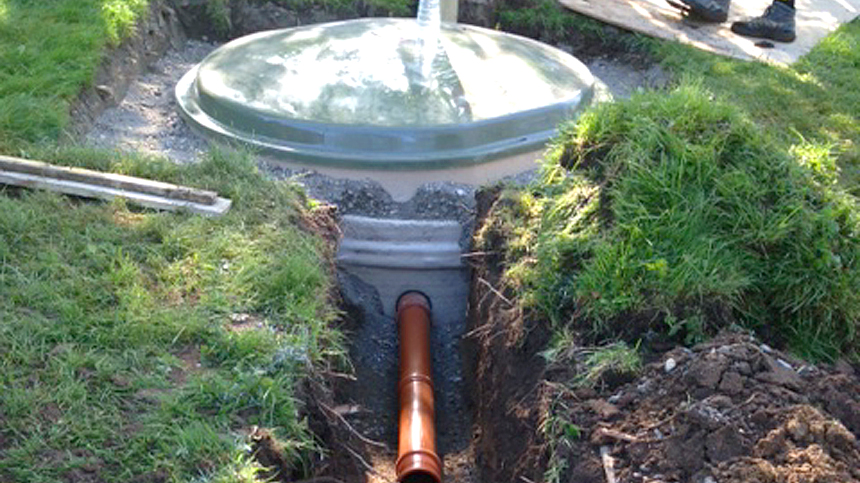
What Are the General Binding Rules?
The General Binding Rules are legally binding requirements covering small sewage discharges from septic tanks and small sewage treatment plants in England. They set minimum conditions which allow qualifying systems to operate without an environmental permit.
They are not simply good-practice recommendations. If you are the operator of a septic tank or sewage treatment plant, you are responsible for making sure the rules that apply to your discharge are met.
In a domestic setting the operator will often be the property owner, although responsibility can become more complicated where a system serves several properties or somebody else controls the treatment system.
The General Binding Rules sit alongside other requirements. Planning permission, Building Regulations, protected-site restrictions, equipment standards and other environmental requirements may still be relevant even where an environmental permit is not required.
You can read the Environment Agency’s official General Binding Rules publication on GOV.UK.
Who Do the General Binding Rules Apply To?
The rules apply to operators making qualifying small discharges of domestic sewage through systems such as septic tanks and small sewage treatment plants.
A genuine cesspool or cesspit is different. It is a sealed holding tank intended to retain sewage until it is removed by tanker. Because it should not discharge sewage to the environment, it is not treated in the same way as a septic tank or treatment plant making a small sewage discharge.
If you are not certain whether a property has a septic tank, sewage treatment plant or cesspool, that distinction needs to be established before the compliance position can sensibly be assessed.
What Counts as a Small Sewage Discharge?
The two headline volume limits are straightforward, although calculating the actual maximum daily discharge can require more care.
| Type of discharge | General Binding Rules threshold | Typical treatment route |
|---|---|---|
| Discharge to ground | 2 cubic metres / 2,000 litres per day or less | Septic tank or sewage treatment plant followed by a suitable drainage field |
| Discharge to surface water | 5 cubic metres / 5,000 litres per day or less | Small sewage treatment plant meeting the applicable rules |
If the maximum daily discharge exceeds the relevant threshold, the system cannot simply rely on the General Binding Rules. Connection to a public foul sewer should be considered where reasonable; otherwise an environmental permit may be required.
The Environment Agency provides a daily discharge calculator for residential properties. Commercial properties and holiday accommodation may require a different calculation based on the nature and use of the premises.
General Binding Rules for Septic Tanks
A septic tank separates solid material from liquid effluent. The liquid leaving the tank has received only partial treatment and normally requires further treatment as it passes through the soil.
For that reason, a septic tank that operates under the General Binding Rules should normally discharge to the ground through a correctly designed drainage field or infiltration system.
The crucial septic tank rule
A septic tank must not discharge directly into a stream, ditch, river or other watercourse. If an existing septic tank does discharge directly to surface water, the drainage arrangement needs to be changed.
Depending on the property, the solution may involve installing a suitable drainage field, replacing the septic tank with an appropriate sewage treatment plant, or connecting to the public foul sewer.
A system also needs to be in good working order, have sufficient capacity, be maintained appropriately and not cause pollution.
General Binding Rules for Sewage Treatment Plants
A modern package sewage treatment plant treats wastewater to a higher standard than a traditional septic tank. This means that, where the relevant rules are satisfied, treated effluent may be discharged either through a drainage field or to suitable flowing surface water.
The presence of a treatment plant does not automatically make an installation compliant. The system still needs to be correctly sized, installed, operated and maintained, and the discharge point itself must satisfy the rules that apply to the property.
Treatment systems also need to meet the relevant design and manufacturing standards that applied when they were installed, and maintenance must be undertaken by somebody competent.
What Are the Rules for Discharging to the Ground?
For a discharge to ground, sewage must first receive appropriate treatment in a septic tank or sewage treatment plant and then normally pass through a drainage field.
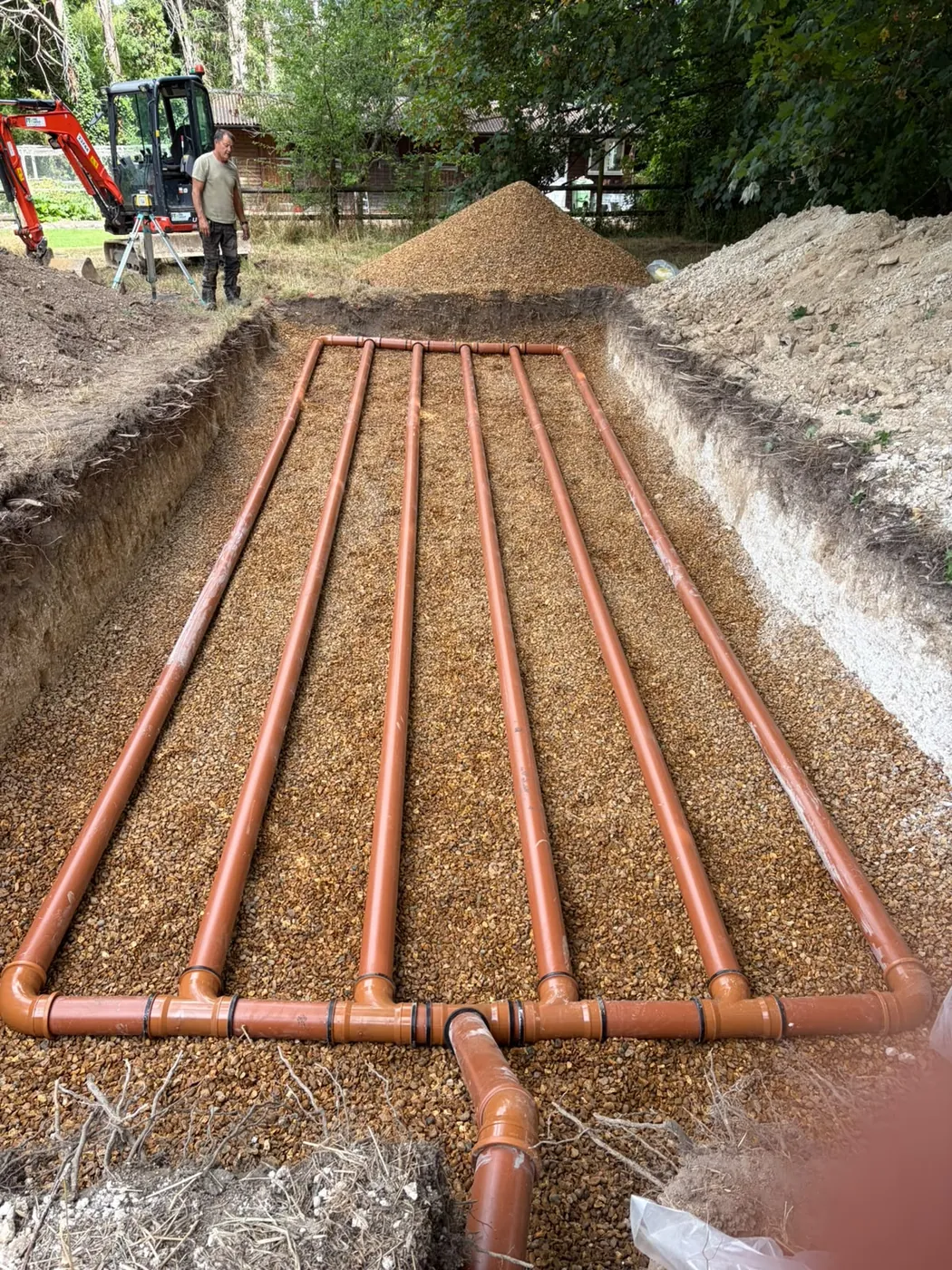
A drainage field is not simply a rainwater soakaway. It is a designed infiltration system in which perforated pipework distributes effluent through the ground so that further treatment can take place within the soil.
The current Environment Agency guidance recognises drainage fields and, subject to specific conditions, certain drainage mounds and engineered-ground solutions designed in accordance with the relevant requirements.
Ground discharges must also avoid unacceptable pollution risks. Particular restrictions apply around groundwater Source Protection Zone 1 and around wells, springs or boreholes used to provide water for domestic consumption or food production.
For new systems, the drainage field should be designed and constructed in accordance with the relevant standards and site conditions. Soil permeability, groundwater, available space, topography and other site factors can all affect whether a drainage field is suitable.
What Are the Rules for Discharging to Surface Water?
Surface water includes rivers, streams, canals, estuaries and certain other watercourses. A discharge to surface water normally needs to come from a suitable small sewage treatment plant rather than a septic tank.
The watercourse must itself be appropriate. The General Binding Rules do not allow every ditch, pond or water feature to be used as an outlet.
For example, the Environment Agency guidance places restrictions on discharges to ditches or surface waters that do not contain flowing water throughout the year, other than during drought or unusually long dry periods. There are also additional restrictions around protected sites and enclosed lakes or ponds.
Can a Septic Tank Discharge Into a Ditch or Stream?
No. A septic tank should not discharge directly into a ditch, stream or other surface water.
This is one of the most important practical points for owners of older rural drainage systems. A system can appear to be functioning perfectly well — toilets flush, drains run and the tank does not overflow — while the discharge arrangement itself is not compliant.
In some cases the eventual discharge point is not obvious. Underground pipework may travel a considerable distance across land before reaching a drainage field, ditch or other outlet.
Where necessary, investigation can involve tracing pipework, CCTV inspection or dye testing to help establish where wastewater ultimately goes.
Do you know where your system actually discharges?
Finding the tank is not always the same as finding the discharge. Boxall Ward can investigate the wider drainage arrangement and provide a written assessment of the accessible system and apparent compliance position.
Arrange a private drainage compliance checkDoes the Age of the Discharge Matter?
Yes. The General Binding Rules that apply depend partly on when the discharge began and whether it has subsequently been changed.
Broadly, the Environment Agency guidance distinguishes between:
- Discharges that were already taking place before 1 January 2015.
- Discharges started on or after 1 January 2015 but before 2 October 2023.
- New discharges started on or after 2 October 2023.
A discharge can also become a new discharge for regulatory purposes following certain material changes — for example, changing between ground and surface-water discharge, moving the discharge point by more than the permitted distance, or increasing its volume beyond specified thresholds.
This is one reason the history of an older private drainage system can matter. The tank visible today may not tell the whole story about when the discharge began or how the installation has changed.
What if There Is a Public Foul Sewer Nearby?
Additional rules apply to discharges started on or after 1 January 2015 concerning proximity to a public foul sewer.
For a single domestic property, the Environment Agency guidance states that the General Binding Rules cannot be met where a public foul sewer is within 30 metres of any boundary of the premises served by the system.
Different calculations apply to developments serving more than one property and to non-domestic premises.
Where connection to the foul sewer is reasonable, that may therefore need to be considered instead of creating or continuing a private discharge.
Can a House Extension Affect Septic Tank Compliance?
Yes. A system that was adequate for the property when installed may no longer have sufficient capacity if the sewage loading increases.
Examples include:
- Extending the house.
- Increasing the number of bedrooms or occupants.
- Converting outbuildings into accommodation.
- Connecting another property to the system.
- Changing the way a property is used.
Where the amount of sewage to be treated increases, the maximum daily discharge needs to be reconsidered and the system must remain large enough for the load placed upon it.
For more detail on this particular problem, see Has Your Property Outgrown Its Septic Tank?
Maintenance Is Part of Compliance
The General Binding Rules do not only concern where sewage is discharged. The treatment system itself must remain in good working order.
Potential signs of a failing system can include leaks, cracks, blocked pipework, sewage smells, pooling wastewater, failed pumps or motors and poor drainage around the discharge area.
Sludge also needs to be removed before it exceeds the system’s capacity. Environment Agency guidance advises desludging at least annually or in accordance with the manufacturer’s instructions.
Neglecting this can allow solids to escape from the tank into a drainage field, potentially damaging the infiltration system and creating a pollution risk.
What Do the General Binding Rules Mean When Selling a Property?
When a property served by a qualifying small sewage discharge is sold, the operator has an obligation to give the new operator written information about the system.
That includes information describing the wastewater system and its maintenance requirements.
In practice, private drainage can become a significant issue during conveyancing because buyers and solicitors may also want to know what system serves the property, its condition, where it discharges and whether there is evidence of a compliance problem.
Boxall Ward has a separate guide covering General Binding Rules and property sales, and buyers can also read our guide to buying a house with a septic tank.
For buyers who want a specialist inspection before exchange, see our septic tank and off-mains drainage homebuyer surveys.
What Changed in the 2026 Guidance?
The Environment Agency updated its guidance for small sewage discharges to ground on 23 July 2026.
The update clarified circumstances in which discharges to ground that has been engineered to reduce the percolation rate can meet the General Binding Rules.
The guidance specifies conditions including location outside floodplains, a minimum percolation value and design and construction in line with the applicable recommendations in BS 6297:2007.
Why this matters
Private drainage guidance changes over time. Advice based on an old article, historic installation or previous property transaction may therefore no longer be enough to establish the position today.
When Is an Environmental Permit Required?
If all of the General Binding Rules that apply to a discharge are satisfied, an environmental permit is not normally required for that small sewage discharge.
If the system cannot meet the relevant rules, the operator may need to:
- Connect to the public foul sewer where reasonable.
- Alter or upgrade the treatment or discharge arrangement so the applicable rules can be met.
- Apply to the Environment Agency for an environmental permit.
A permit does not simply provide a way of ignoring an unsuitable system. The Environment Agency assesses the environmental risks and can impose conditions or require changes where necessary.
What Happens if a Septic Tank or Treatment Plant Does Not Comply?
Finding a compliance problem does not automatically mean that the whole drainage system has to be replaced.
The appropriate solution depends on the problem. In some cases maintenance or repair may be enough. Other properties may require further investigation, a new drainage field, a change to the discharge arrangement, replacement of an old septic tank with a sewage treatment plant, or connection to the public sewer.
That is why a specialist inspection considers more than the tank itself. The discharge route, drainage field, visible condition, system capacity, maintenance history and information available about the installation may all matter.
How Can Boxall Ward Help With the General Binding Rules?
Boxall Ward specialises in private off-mains drainage and works with septic tanks, sewage treatment plants, drainage fields and associated pipework across Sussex and the wider South East.
Where an owner is unsure about an existing system, our off-mains drainage compliance service can help establish the condition and apparent compliance of the accessible drainage arrangement.
Depending on the property and the investigation required, this can include consideration of:
- The type of system installed.
- The condition of accessible tank components.
- Where the system appears to discharge.
- The drainage field or infiltration arrangement where identifiable.
- Signs of leakage, saturation, damage or pollution.
- System capacity and changes to the property.
- Available installation, maintenance and servicing information.
- Relevant General Binding Rules considerations.
- Whether further investigation or remedial work may be appropriate.
Where a problem is identified, Boxall Ward can also advise on practical next steps rather than simply handing the owner a list of defects.
Concerned about your septic tank, treatment plant or drainage field?
Whether you are dealing with an existing property, preparing for a sale, buying a home or simply want to understand an off-mains drainage system better, Boxall Ward can inspect the system and explain the findings in plain English.
Talk to Boxall WardGeneral Binding Rules FAQs
What are the General Binding Rules for septic tanks?
They are legally binding conditions governing qualifying small sewage discharges in England. If all of the rules that apply to a septic tank or small sewage treatment plant are met, the discharge can normally operate without an environmental permit.
Can a septic tank discharge directly into a ditch?
No. Septic tank effluent should not discharge directly into a ditch, stream or other surface water. A septic tank normally needs to discharge to ground through an appropriate drainage field.
Can a sewage treatment plant discharge into a watercourse?
Potentially, yes. A suitable small sewage treatment plant can discharge treated effluent to appropriate flowing surface water where all of the relevant General Binding Rules are met. Restrictions apply to the type and location of the receiving water.
How much can a septic tank discharge under the General Binding Rules?
For a discharge to ground, the General Binding Rules threshold is normally 2 cubic metres, or 2,000 litres, per day. Surface-water discharges have a separate threshold of 5 cubic metres, or 5,000 litres, per day.
Do the General Binding Rules apply to cesspools?
A genuine cesspool is a sealed holding tank that should not discharge sewage to the environment. It therefore differs from a septic tank or sewage treatment plant making a small sewage discharge.
Does a house extension affect septic tank compliance?
It can. If an extension, additional accommodation or another connected property increases the sewage loading, the maximum daily discharge must be reconsidered and the treatment system must remain large enough for the increased load.
Do I need an environmental permit for my septic tank?
Not necessarily. If the discharge qualifies as a small sewage discharge and meets every General Binding Rule that applies to it, an environmental permit is normally not required. If the relevant rules cannot be met, a permit or a change to the drainage arrangement may be necessary.
Do I need a septic tank compliance certificate?
There is no standard Environment Agency “septic tank compliance certificate”. A specialist company can inspect the drainage system and provide a written report setting out its findings and apparent compliance position.
Do the General Binding Rules apply when selling a house?
Yes. Among other requirements, the operator must provide the new operator with written information about the private sewage system when the property changes hands. A property transaction can also bring existing drainage or compliance problems to light.
What should I do if I do not know where my septic tank discharges?
It is worth establishing the discharge route rather than assuming it is compliant. Depending on the property, investigation may involve inspection of chambers and pipework, CCTV or dye testing to help identify where the effluent ultimately goes.
Need a clear answer about your private drainage?
Boxall Ward provides specialist off-mains drainage compliance checks, homebuyer surveys, servicing, repairs and replacement systems across Sussex and the South East.
Contact Boxall WardOfficial guidance: General Binding Rules — discharges to ground and General Binding Rules — discharges to surface water.
Last reviewed: October 2026.
