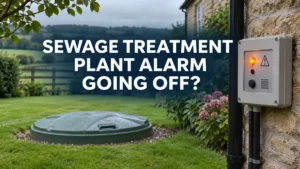
Sewage Treatment Plant Alarm Going Off?
What It Means and What to Do
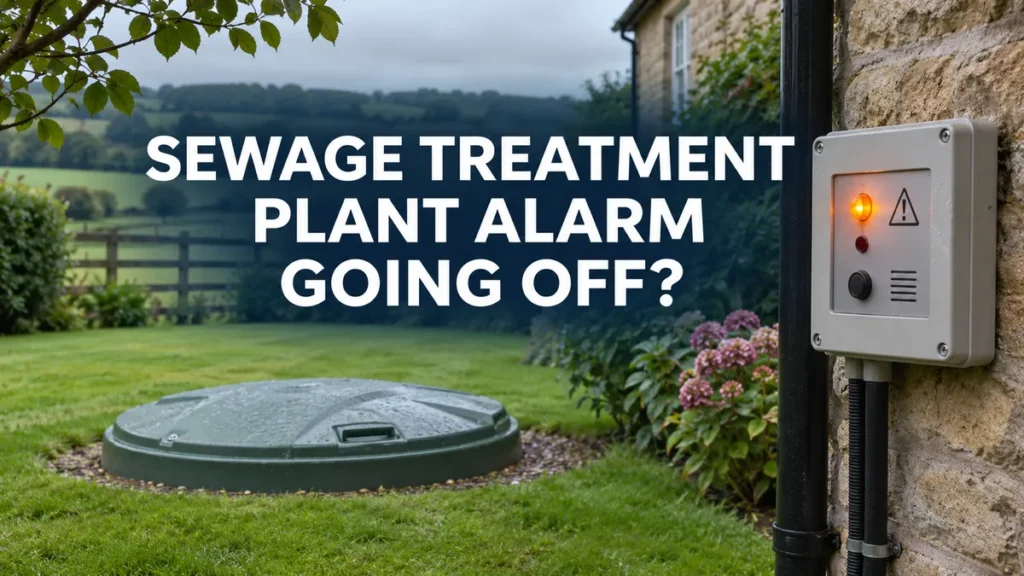
There’s a noise you probably don’t want to hear coming from the bottom of your garden.
Your sewage treatment plant alarm.
Perhaps it’s started beeping unexpectedly. Maybe there’s a flashing warning light on the control panel. Or perhaps the alarm has been going off intermittently for several days.
What does it mean? And, more importantly, what should you do about it?
The good news is that an alarm doesn’t necessarily mean your entire sewage treatment system has failed. However, it does mean something needs attention, and ignoring it could turn a relatively straightforward repair into a much more serious drainage problem.
Quick Answer
If your sewage treatment plant alarm is going off, it usually indicates a problem with the air blower, pump, water level, electrical supply or control system. The exact meaning depends on the make and model of your plant. Check the warning displayed, reduce water use if there are signs of a high water level, and arrange for the fault to be investigated. An alarm doesn’t automatically mean the treatment plant needs replacing, but it shouldn’t simply be ignored or repeatedly reset.
Why Is Your Sewage Treatment Plant Alarm Going Off?
Modern sewage treatment plants rely on biological treatment and, depending on the system, mechanical and electrical components.
These may include air blowers, pumps, control panels, sensors and warning systems.
When something stops working as it should, an alarm can provide an early warning before a more serious problem develops.
There are three main areas worth investigating.
1. The Air Blower Has Stopped Working Properly
Many sewage treatment plants use an air blower to supply oxygen to the bacteria responsible for breaking down waste.
Without sufficient oxygen, the biological treatment process can become less effective.
A problem with the blower may be caused by:
- A damaged diaphragm or another worn component.
- A blocked air filter or restricted airflow.
- An electrical supply problem.
- A fault with the blower itself.
You might notice that a plant that normally makes a humming sound has suddenly become unusually quiet.
However, not every treatment system operates continuously, so the manufacturer’s instructions are important when interpreting what you hear.
The solution: A service engineer can check the blower, air supply and associated components to establish the fault. In some cases, replacing a relatively small component may restore normal operation.
A failed blower doesn’t automatically mean the whole treatment plant needs replacing.
2. The Water Level Inside the Plant Is Too High
Another common reason for an alarm is that wastewater is not leaving the system as it should.
Depending on the installation, treated wastewater may leave by gravity or be pumped to a drainage field or suitable discharge point.
If that process is interrupted, the water level can rise.
Possible causes include:
- A failed or obstructed discharge pump.
- Blocked or damaged outlet pipework.
- A drainage field that is no longer dispersing wastewater effectively.
- A fault affecting the level sensor or pump controls.
If the water level continues rising, wastewater may eventually back up towards the property or overflow.
The solution: The first step is to establish why the water isn’t leaving the system correctly.
A faulty pump or damaged pipe may be repairable. Where the problem lies with a saturated or failing drainage field, further investigation may be necessary.
This is particularly important if the problem keeps returning after heavy rainfall.
The aim is to repair the actual fault rather than repeatedly dealing with the resulting high water level.
For more information on recurring drainage problems, see our article Septic Tank Full Again After Emptying? Why It Happens and What to Do.
3. There’s an Electrical or Control System Fault
Sometimes the alarm is caused by the equipment controlling the treatment plant rather than the wastewater treatment process itself.
A power interruption, faulty sensor, damaged connection or problem with the control panel can trigger a warning.
For example, a plant may display an alarm following a power cut, even after electricity has been restored.
But it’s important not to assume that a warning is harmless simply because the power is back on.
The alarm may be indicating that a pump, blower or another component has failed to restart correctly.
The solution: Check the external control panel and follow the manufacturer’s instructions. If the problem persists, a suitably qualified engineer should investigate.
Electrical components and control panels should not be opened or repaired by an unqualified person.
What Should You Do When the Alarm Starts?
If your sewage treatment plant alarm starts sounding, there are some sensible steps you can take without attempting to repair the system yourself.
- Check the warning. Make a note of any lights, messages or fault codes displayed on the control panel. These can help an engineer identify the problem.
- Look for obvious symptoms. Are the toilets draining normally? Is wastewater appearing around the plant? Has there been a recent power cut?
- Avoid unnecessary water use. If the plant may be backing up, reduce activities such as running the washing machine or dishwasher until the problem has been assessed.
- Don’t simply switch the system off. Many sewage treatment plants need electrical power to operate correctly. If the manufacturer provides an alarm-mute function, follow its instructions rather than disconnecting the plant.
- Arrange professional advice. A recurring alarm or persistent fault should be investigated rather than repeatedly reset.
Never enter a sewage treatment tank or lean inside one. Confined spaces, sewage gases, contaminated wastewater and electrical equipment can present serious hazards.
Can You Keep Using Your Toilets When the Alarm Is Sounding?
That depends on the fault.
If a blower has stopped working but wastewater can still pass through the system, an immediate blockage may not occur. However, treatment performance can deteriorate, so the problem still needs prompt attention.
A high-water-level alarm is different.
If wastewater cannot leave the plant, continued water use may make the situation worse and increase the risk of sewage backing up or overflowing.
If toilets are backing up, wastewater is escaping or the system appears close to overflowing, minimise wastewater entering the system and seek urgent professional advice.
Does an Alarm Mean You Need a New Sewage Treatment Plant?
Not necessarily.
Many faults can be addressed through servicing or replacement of individual components.
Depending on the condition of the existing system, the answer might involve:
- Repairing or replacing an air blower.
- Repairing a pump or level sensor.
- Clearing or repairing drainage pipework.
- Servicing the treatment plant and correcting maintenance problems.
- Investigating the drainage field or discharge arrangement.
However, if a treatment plant is seriously deteriorated, unsuitable for the property or repeatedly experiencing major failures, replacement may be the more appropriate long-term option.
The important thing is to understand the cause before making that decision.
Boxall Ward provides off-mains drainage repairs, including repairs to existing sewage treatment plants and associated equipment.
Regular Servicing Can Help Prevent Problems
A sewage treatment plant is not something that should be installed and then forgotten about.
Regular servicing can help identify worn components, deteriorating performance and potential faults before they cause a breakdown.
The appropriate servicing frequency depends on the manufacturer’s recommendations and the system’s use.
At Boxall Ward, we provide sewage treatment plant servicing, maintenance and repairs, helping property owners keep their private drainage systems working correctly.
Our service engineers work with a wide range of sewage treatment plants, carrying out inspections and maintenance and arranging repairs or replacement components where necessary.
You can find out more about our sewage treatment plant servicing and maintenance.
Frequently Asked Questions
Is a sewage treatment plant alarm an emergency?
Not every alarm means an immediate emergency, but it should be taken seriously. A high-water-level warning, sewage backing up or wastewater overflowing requires particularly prompt attention.
Can I silence the alarm myself?
Some systems have a mute function, which can stop the audible warning while the problem is investigated. Silencing the buzzer does not fix the underlying fault. Always follow the manufacturer’s instructions.
Why is my treatment plant alarm going off after a power cut?
A power interruption can affect the blower, pumps or control system. Some systems retain a fault warning until normal operation has been restored or the alarm has been reset. If the plant has not restarted correctly or the warning persists, arrange an inspection.
Can a faulty sewage treatment plant be repaired?
Often, yes. Blowers, pumps, controls and some pipework faults can be repaired or individual parts replaced. More substantial problems may require further investigation or replacement of part or all of the system.
The Bottom Line: Don’t Ignore the Warning
A sewage treatment plant alarm is there for a reason.
Sometimes it indicates a relatively simple fault. Sometimes it’s an early warning of a problem that could cause wastewater to back up, damage the system or create a pollution risk.
Either way, ignoring the warning is rarely the best approach.
Boxall Ward has experience in servicing, maintaining and repairing sewage treatment plants and associated off-mains drainage systems.
We work with property owners across Sussex, Surrey, Hampshire, Kent, the New Forest and the wider South East.
If your sewage treatment plant alarm keeps going off, contact Boxall Ward to discuss the problem and arrange appropriate assistance.
Contact Boxall Ward online or call 01903 815377.