
Septic Tank Full Again After Emptying? Why It Happens and What to Do
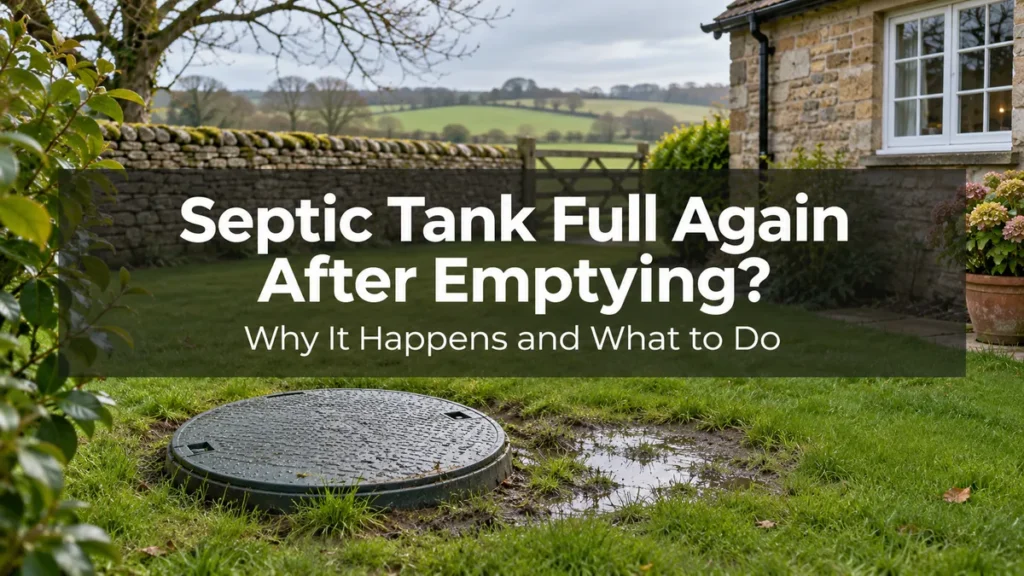
You’ve paid to have your septic tank emptied. Everything seems fine for a while. Then the toilets start draining slowly, unpleasant smells return, or wastewater begins collecting around the tank.
Surely it shouldn’t be full again already?
It’s a frustrating situation, particularly when you’ve already spent money trying to put things right. But here’s something many homeowners don’t realise: emptying a septic tank and fixing a septic tank problem are not necessarily the same thing.
In fact, the tank itself might not be the problem at all.
Quick Answer
It is normal for a septic tank to refill to its operating level shortly after emptying. However, if wastewater is backing up, overflowing or failing to drain away, there may be an underlying problem. Common causes include blocked pipes, a saturated or failing drainage field, excessive groundwater or a system that can no longer cope with the property’s demands. Repeated emptying may provide temporary relief, but the key to a lasting solution is identifying and correcting the underlying fault.
1. Your Septic Tank Might Be Working Perfectly
This sounds strange, but a septic tank isn’t supposed to remain empty.
When wastewater enters the tank, solids settle to the bottom while lighter materials rise to the surface. The liquid gradually flows out towards the drainage field, where it receives further treatment as it passes through the ground.
The tank normally holds liquid at approximately the level of its outlet pipe.
So if you’ve recently had your tank emptied and can already see water inside, don’t panic. That’s how the system is designed to operate.
The warning signs are different: wastewater rising above its normal level, toilets backing up, persistent unpleasant smells or sewage appearing where it shouldn’t.
These symptoms suggest that wastewater may not be moving through the system correctly.
2. The Drainage Field Could Be Failing
This is one of the most important possibilities to investigate.
A septic tank is only part of a larger drainage system. After wastewater leaves the tank, it normally passes into an underground drainage field, sometimes called a septic tank soakaway.
The drainage field allows the liquid to receive further treatment and disperse gradually into suitable soil.
But what happens if the ground can no longer absorb it?
The wastewater has nowhere to go.
It may begin backing up towards the septic tank, causing the liquid level to rise and potentially leading to overflowing or drainage problems inside the property.
A drainage field can struggle for several reasons:
- Ground that has become saturated after prolonged rainfall.
- Unsuitable soil conditions.
- A build-up of solids that restricts infiltration.
- Damaged or collapsed underground pipework.
- A drainage field that is incorrectly designed or too small.
The solution: A specialist assessment can help establish whether the drainage field is temporarily affected by ground conditions, has a repairable problem or requires replacement.
Simply arranging another tanker visit won’t restore a drainage field that has permanently failed.
A Real Example: Drainage Field Replacement in Hampshire
Boxall Ward recently replaced a failed drainage field at a property in Droxford, Hampshire.
The existing septic tank was retained, while a new drainage field was installed to restore the system’s ability to discharge wastewater into the ground.
It’s a useful example of why identifying the faulty component matters. A drainage field problem doesn’t automatically mean that the septic tank itself must be replaced.
See how Boxall Ward replaced a failed drainage field in Droxford, Hampshire.
3. There Could Be a Blockage Between the Tank and Drainage Field
Sometimes the explanation is more straightforward.
A damaged or obstructed outlet pipe can prevent wastewater from leaving the tank, even when the drainage field itself remains usable.
Blockages can develop through accumulated solids, debris, root intrusion or damaged pipework.
If the obstruction remains in place after the tank has been emptied, the drainage problems may quickly return.
The solution: Inspection of the relevant pipework can help identify restrictions, damage or other defects. Depending on the findings, clearing a blockage or repairing a section of pipe may resolve the problem without major excavation.
This is why diagnosis should come before deciding that an entire system needs replacing.
Boxall Ward also provides off-mains drainage repairs and maintenance advice for existing installations.
4. Heavy Rainfall Could Be Making the Problem Worse
Have you noticed that your septic tank problems seem to coincide with wet weather?
That’s a useful clue.
When the surrounding ground becomes saturated, a drainage field may struggle to disperse wastewater. High groundwater levels can also contribute to problems, particularly where tanks or connecting pipes are damaged or poorly sealed.
The result can be recurring drainage trouble during prolonged periods of rain.
However, it’s important not to assume that every wet-weather problem is temporary.
If the same thing happens winter after winter, the drainage field or wider system may need further investigation.
The solution: Assess the condition of the tank, pipework and drainage field alongside the site’s ground conditions. The appropriate remedy will depend on the cause, rather than simply how much rain has fallen.
5. Your Property Might Have Outgrown Its Drainage System
An older rural property may have undergone considerable changes since its septic tank was originally installed.
Perhaps the house has been extended, additional bedrooms have been created, or an annexe has been converted into accommodation.
Each change can increase the amount of wastewater entering the system.
A drainage arrangement that worked adequately for the original property may struggle with the additional demand.
It’s also possible for the treatment tank to be adequately sized while the drainage field is not.
The solution: The capacity of the complete system should be assessed against the property’s current requirements.
We explore this in more detail in our article Has Your Property Outgrown Its Septic Tank?
What Should You Do If the Problem Keeps Coming Back?
If your septic tank has been emptied recently but you’re still experiencing drainage problems, the most useful next step is to establish exactly where the system is failing.
Until the problem has been assessed:
- Reduce unnecessary water use if wastewater is backing up or overflowing.
- Keep children and pets away from any suspected sewage contamination.
- Avoid pouring chemical drain cleaners into the system in an attempt to solve an unknown problem.
- Don’t enter a septic tank or attempt to inspect its interior yourself.
- Seek professional advice before arranging repeated emptying, particularly during flooding or high groundwater conditions.
A specialist can investigate the tank, connecting pipework, discharge arrangements and drainage field, recommending further tests where necessary.
The findings may point towards a relatively straightforward repair, additional maintenance, drainage field replacement or a more substantial system upgrade.
The aim should always be to identify a suitable long-term solution rather than repeatedly treating the symptoms.
Does a Failed Drainage Field Mean You Need a New Septic Tank?
Not necessarily.
If the existing tank remains suitable, structurally sound and compliant with the applicable requirements, it may be possible to retain it and replace the failed drainage field.
In other circumstances, particularly where the existing installation is unsuitable or no longer meets the relevant environmental requirements, a sewage treatment plant or different drainage arrangement may be appropriate.
The Environment Agency’s General Binding Rules for small sewage discharges to ground set out important requirements for systems operating in England.
Every property is different, which is why the right recommendation depends on the existing installation and site conditions.
Frequently Asked Questions
Is it normal for a septic tank to fill up quickly after emptying?
Yes. A working septic tank normally contains liquid up to its outlet level. Problems arise when wastewater cannot leave the system correctly, backs up or overflows.
Will emptying my septic tank again solve the problem?
It may provide temporary relief in some circumstances, but it will not repair blocked pipework, a failed drainage field or an unsuitable discharge arrangement. Repeated problems should be investigated.
Can a drainage field be repaired, or must it be replaced?
That depends on the cause. Some pipework faults can be repaired, but a drainage field that has permanently lost its ability to disperse wastewater may need replacing. A specialist assessment is needed before recommending a solution.
Stop Paying for the Same Problem Twice
If your septic tank keeps causing problems despite regular emptying, it’s worth finding out why.
At Boxall Ward, we specialise in off-mains drainage systems, including septic tanks, sewage treatment plants, drainage fields and associated repairs.
We can assess the existing installation, investigate the likely cause of recurring problems and recommend an appropriate solution.
Whether the answer is a repair, replacement drainage field or an upgraded sewage treatment system, our aim is to help you get the problem resolved properly.
We work with homeowners across Sussex, Surrey, Hampshire, Kent, the New Forest and the wider South East.
Don’t keep paying to empty a tank without understanding why the problem returns.
Contact Boxall Ward to discuss your septic tank problem or call 01903 815377.