
Septic Tank Guide
What is a septic tank?
Modern septic tanks are small scale sewage treatment systems, ideal for people living in areas that have no connection to the main sewage pipes. In the UK, these tend to be in rural areas. They tend to be plastic tanks, with a pipe at one end for incoming waste to enter the tank and another at the other end.
Waste enters the tank and is then stored so that the solids, oils and greases can separate from the liquid. Once treated thus, a second pipe at the other end of the tank releases the liquids.
Though considerably cleaner than when it entered the tank, this waste is nowhere near clean enough to directly enter the eco-system again, so it is generally dispersed to a soakaway or drainage field. This is essentially feeding it into a designated patch of land, which must first be assessed for its suitability. This process is strictly controlled by UK Government Legislation.
This leaves an ever-increasing residue of solid matter in the tank, of course, which is where you’ll want a professional to regularly carry out emptying duties.
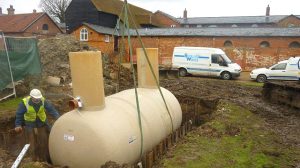
Septic Tank Installation
Septic Tanks may be installed in applications where:
- Soil is of suitable porosity.
- Installation complies with Building Regulations (Approved Document H).
- The installation will not contaminate any ditch, stream or other watercourse.
Septic Tank Care and Maintenance
Regular care and maintenance of your Sewage Treatment Plant will ensure the prolonged life of the component parts such as pumps, blowers and motors and avoid unwelcome costs associated with replacement. It is therefore, highly recommended.
At each service visit our British Water Accredited Engineer will carry out a detailed service of your Sewage Treatment Plant in accordance with the manufacturers specifications. This will ensure the treated effluent being discharged is up to the standard required and in accordance with the Environment Agency requirements.
There are also guidelines you can follow at home to reduce the wear and tear on your off-mains drainage system:
- Try to avoid putting too much water through the system – it can upset the delicate biological balance within the tank.
- Don’t use excessive amounts of any household chemicals
- Don’t put coffee grounds, cooking fats, disposable nappies, facial tissues, cigarette butts, or other non-decomposable materials into the house sewer.
- Try to avoid dumping grease down the drain.
Septic Tank Emptying
As previously mentioned, there is only so much scum and sludge that a tank can hold, so it does need regular emptying. Obviously factors such as the size of the tank, number of people living in the house and generally how much you are putting into the tank will all affect how often it needs to be emptied.
Its always worth asking an expert in these situations because its something you can’t afford to get wrong – a failure to desludge frequently enough can result in blocking up your drainage field and you really don’t want to go there!
Septic Tank Costs
As I’m sure you can imagine from the above, it is absolutely essential that all parts of the septic tank process – from installation to maintenance and emptying – are carried out by experienced professionals with a great reputation and many years of experience.
Costs can of course vary depending on each individual situation, so please call us on 01903 815377 if you’d like to discuss your specific needs.